AI Referent
Engineering lead for a legal analytics platform — architecture, full-stack delivery, and production reliability for audit workflows.
Graphics by@tatiana_spesivtseva
company
AI Referent
site
ai-referent.ru ↗role
Lead Software Engineer
period
2024 — present
Engineering lead for a legal analytics platform — architecture, full-stack delivery, and the practices that keep audit workflows reliable in production.
frontend
React, TypeScript, Effector
backend
Node.js, Python, ClickHouse, Postgres, Apache Superset
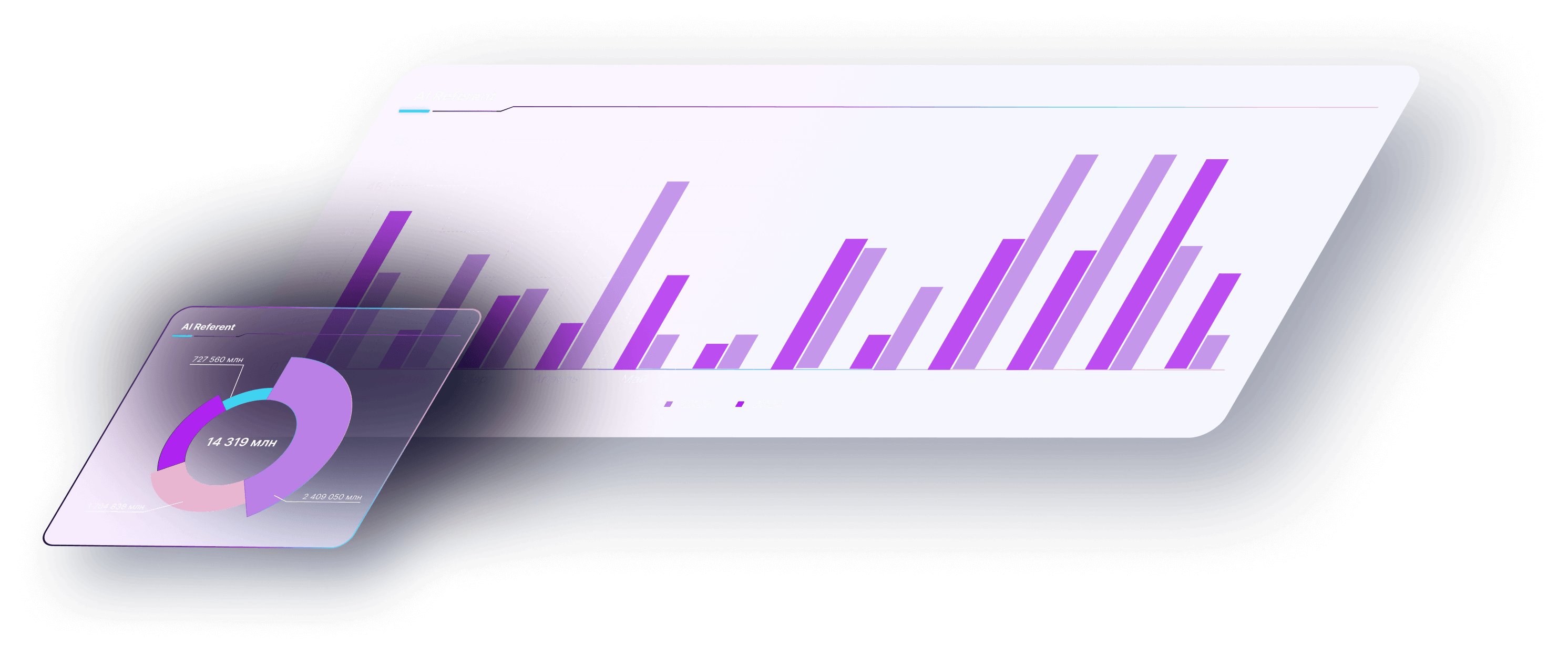
High-performance platform for legal analytics and audit automation — contracts, bank statements, tax data, registry records, and bankruptcy insights for fintech and insolvency professionals. The product combines embedded analytics, dashboards, statistical tables, complex forms, and ready-made report file uploads.
I lead product engineering at AI Referent: technical direction, architecture, and hands-on delivery across frontend, Node.js and Python services, and integration with analytics and the broader service stack. Product and the team come to me for engineering decisions; I stay in the code where delivery speed and quality depend on it.
- Technical direction and architecture
- Frontend platform — UI kit, component libraries, application patterns
- Backend services — Node.js and Python (report generation, file ingestion, product APIs)
- Analytical reports cluster
- Application integration layer
- GitLab delivery workflows and engineering standards
- Embedded analytics — day-to-day implementation owned by a dedicated engineer; I step in on integration and architecture
- Java services in the stack — code review and architecture-level pattern checks; I do not write Java
Set technical direction and own the architecture decisions that shape the product — how frontend, integrations, and supporting services fit together, where boundaries sit, and what trade-offs are worth taking as features and data flows grow more complex.
Work with product as the engineering counterpart on scope and priorities: translating goals into something buildable, pushing back when complexity does not earn its place, and keeping delivery predictable as requirements shift.
- Built and evolve Node.js services supporting report generation, file ingestion, and product APIs
- Contribute to Python services — data processing, integrations, and supporting backend workflows where delivery needs hands-on input
- Own the frontend platform: shared UI kit, in-house component libraries, core helpers, and application patterns for data-heavy interfaces, complex forms, and report uploads
- Review Java service code at architecture boundaries — pattern checks and integration fit; implementation stays with the team
- Shaped how the application integrates with backend services — clearer boundaries and a maintainable integration layer as the product grew
Built the analytical reports cluster end to end — a distinct part of the product from embedded analytics. Users upload ready-made report files; staff validate and correct them in a UI editor during processing; supporting services handle automated analytical report generation downstream.
The workflow reduced correction cycles in audit pipelines and made document handling a first-class part of the application, not an afterthought bolted onto forms and tables.
The embedded analytics experience runs on Apache Superset and ClickHouse with a dedicated owner on the team. I step in when integration or architecture questions come up; I do not claim day-to-day ownership of that track.
Established code review, mentoring, and engineering documentation as the team scaled. Shaped GitLab-based delivery workflows around team requirements — enough structure to ship reliably, without turning infrastructure into a separate identity.
Rolled out AI agent workflows and tooling across every delivery stage — not as a demo, but as daily practice. Scaffolding, review prep, documentation, and routine implementation work now run through agents and internal tools the team actually uses. Measured result: development speed increased roughly 3× compared to the pre-agent baseline.
Helped other developers onboard faster, raised the quality bar through review and written standards, and kept practices practical: the kind of engineering culture that reduces bugs and context loss, not process for its own sake.
Designed how the application integrates with backend services as the stack grew: clearer boundaries between product and services, less one-off wiring per feature, and an integration approach the team could extend without rewriting the frontend each time.
This is boundary and integration design work — making the product stack legible to the team — rather than claiming deep ownership of every downstream system.
- Introduced AI agent workflows across all delivery stages — scaffolding, review prep, documentation, and implementation support — increasing team development speed ~3×.
- Built the analytical reports cluster end to end, reducing correction cycles in audit pipelines.
- Designed integration boundaries so the product stack scales without rewriting the frontend per feature.